We have characterized recurrence in terms of return times. However, if a Markov chain is positive recurrent, what proportion of time does it spend in each state?
Theorem. For an irreducible positive recurrent Markov chain, there exists a probability distribution 

![\displaystyle \frac{1}{T} \sum_{t=1}^T \mathbb{I}[X_t = x] \to \pi(x) \quad \text{as } T \to \infty](https://s0.wp.com/latex.php?latex=%5Cdisplaystyle+%5Cfrac%7B1%7D%7BT%7D+%5Csum_%7Bt%3D1%7D%5ET+%5Cmathbb%7BI%7D%5BX_t+%3D+x%5D+%5Cto+%5Cpi%28x%29+%5Cquad+%5Ctext%7Bas+%7D+T+%5Cto+%5Cinfty&bg=ffffff&fg=1a1a1a&s=0&c=20201002)
Moreover, 

Conversely, if the full balance equations have a solution, then the Markov chain is positive recurrent.
The distribution

- When the above convergence holds, the chain is called ergodic.
- The distribution
is called the stationary (or equilibrium) distribution.
- The full balance equations can also be written as

This can be interpreted as: the proportion of time entering state 
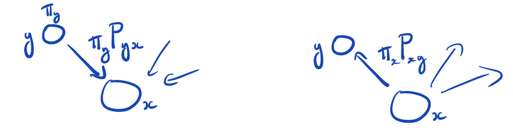
Figure: flow of probability into and out of a state.
Reversibility
Instead of full balance, we may require that transitions between each pair of states balance. This is called detailed balance.
Definition. A distribution 

- Detailed balance implies full balance, and hence gives a stationary distribution.
- It is often easier to verify detailed balance than full balance.
- Many Markov chains (especially in Monte Carlo methods) are designed to be reversible.
Definition (Time reversal and reversibility). For a Markov chain 

The chain is reversible if 

Theorem. A Markov chain is reversible if and only if it satisfies the detailed balance equations.
Discrete-time single-server queue (continued)
For the discrete-time single-server queue, it is easier to verify detailed balance.
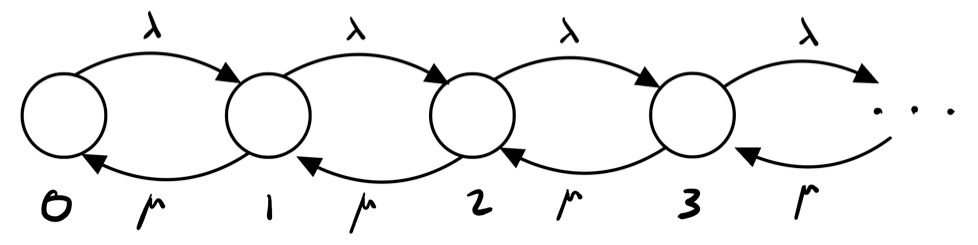
Figure: transition structure of the queue.
We have

so

To normalize, we require

which gives

Hence

Thus, the stationary distribution is geometric. Many queueing systems with fixed service rates exhibit this geometric structure.

