The Poisson process is a fundamental object in probability. Just as we have a uniform distribution for a single point in an interval, we would like a notion of a “uniform” distribution for a countable set of points in 
Motivation for the Poisson process
Suppose there is a large town where the probability of a phone call in any given minute is independent, with probability 
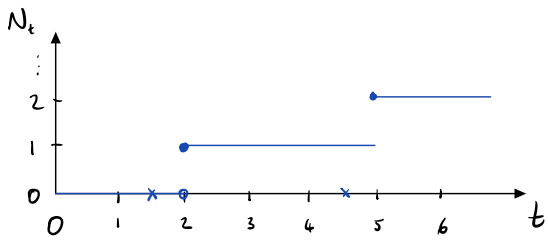
Figure: number of calls counted after each minute.
How many minutes are there until the first call occurs? This follows a geometric distribution.
How many calls are there after 10 minutes? This follows a binomial distribution.
Now suppose we divide time into intervals of size 

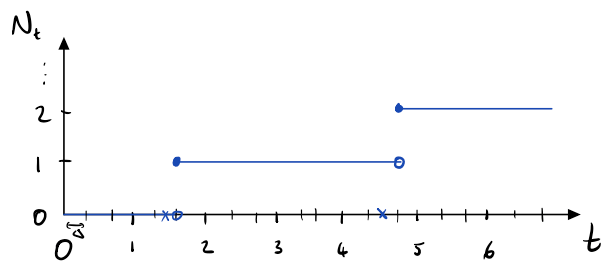
Figure: number of calls counted over intervals of size
How much time is there until the first call? This is still geometric:

How many calls occur after 

Now let 
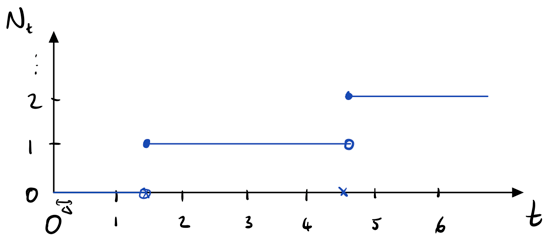
Figure: the limiting continuous-time process.
The geometric distribution converges to an exponential distribution:

The binomial distribution converges to a Poisson distribution:

The resulting process has exponentially distributed waiting times between events, and the number of events in any interval is Poisson distributed.
Poisson process: coin-tossing intuition
The previous example gives useful intuition. Imagine tossing a coin at every point along the real line, where the probability of heads is very small. Each time the coin lands heads, we record a point in our process.
This illustrates two key ideas:
- Counts in disjoint time intervals are independent.
- The waiting time to the next “head” is exponential.
The process is memoryless: observing a head at one time does not influence when the next head occurs.
Poisson process: a formal definition
Let 


Then 

The jump times are given by

The set of times 
The Poisson process is Poisson
Proposition.


