We quickly recap the recurrence properties of Markov chains. The aim is to give a short review not a full rigorous treatment.
Recurrence and Transience
For a Markov chain 

![\displaystyle \text{recurrent} \quad \text{if} \quad \sum_{t=1}^{\infty} \mathbb{I}[X_t = x] = \infty \quad \text{with probability 1}](https://s0.wp.com/latex.php?latex=%5Cdisplaystyle+%5Ctext%7Brecurrent%7D+%5Cquad+%5Ctext%7Bif%7D+%5Cquad+%5Csum_%7Bt%3D1%7D%5E%7B%5Cinfty%7D+%5Cmathbb%7BI%7D%5BX_t+%3D+x%5D+%3D+%5Cinfty+%5Cquad+%5Ctext%7Bwith+probability+1%7D&bg=ffffff&fg=1a1a1a&s=0&c=20201002)
![\displaystyle \text{transient} \quad \text{if} \quad \sum_{t=1}^{\infty} \mathbb{I}[X_t = x] < \infty \quad \text{with probability 1}](https://s0.wp.com/latex.php?latex=%5Cdisplaystyle+%5Ctext%7Btransient%7D+%5Cquad+%5Ctext%7Bif%7D+%5Cquad+%5Csum_%7Bt%3D1%7D%5E%7B%5Cinfty%7D+%5Cmathbb%7BI%7D%5BX_t+%3D+x%5D+%3C+%5Cinfty+%5Cquad+%5Ctext%7Bwith+probability+1%7D&bg=ffffff&fg=1a1a1a&s=0&c=20201002)
![\displaystyle \text{positive recurrent} \quad \text{if} \quad \liminf_{T \to \infty} \frac{1}{T} \sum_{t=1}^{T} \mathbb{I}[X_t = x] > 0 \quad \text{with probability 1}](https://s0.wp.com/latex.php?latex=%5Cdisplaystyle+%5Ctext%7Bpositive+recurrent%7D+%5Cquad+%5Ctext%7Bif%7D+%5Cquad+%5Climinf_%7BT+%5Cto+%5Cinfty%7D+%5Cfrac%7B1%7D%7BT%7D+%5Csum_%7Bt%3D1%7D%5E%7BT%7D+%5Cmathbb%7BI%7D%5BX_t+%3D+x%5D+%3E+0+%5Cquad+%5Ctext%7Bwith+probability+1%7D&bg=ffffff&fg=1a1a1a&s=0&c=20201002)

Thus, a state
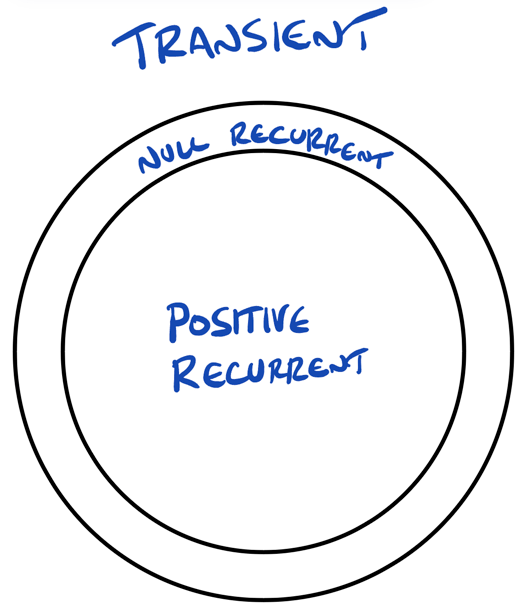
Figure: a Venn diagram of the definitions above.
In queueing systems, we typically want the empty state to be positive recurrent, while transience would be undesirable. Null recurrence can be viewed as a borderline case.
Hitting Times and Recurrence
We can characterize recurrence in terms of return times. Let

and define
![\displaystyle h_x = \mathbb{P}_x(\tau_x < \infty), \quad H_x = \mathbb{E}_x[\tau_x]](https://s0.wp.com/latex.php?latex=%5Cdisplaystyle+h_x+%3D+%5Cmathbb%7BP%7D_x%28%5Ctau_x+%3C+%5Cinfty%29%2C+%5Cquad+H_x+%3D+%5Cmathbb%7BE%7D_x%5B%5Ctau_x%5D&bg=ffffff&fg=1a1a1a&s=0&c=20201002)
Then we have the following characterizations.
Proposition. The state


These quantities can be computed using the transition matrix 
For 
![\displaystyle h(x_0) = \mathbb{P}_{x_0}(\tau_x < \infty), \quad H(x_0) = \mathbb{E}_{x_0}[\tau_x]](https://s0.wp.com/latex.php?latex=%5Cdisplaystyle+h%28x_0%29+%3D+%5Cmathbb%7BP%7D_%7Bx_0%7D%28%5Ctau_x+%3C+%5Cinfty%29%2C+%5Cquad+H%28x_0%29+%3D+%5Cmathbb%7BE%7D_%7Bx_0%7D%5B%5Ctau_x%5D&bg=ffffff&fg=1a1a1a&s=0&c=20201002)
and set 

Theorem. For any 


and 

Proof (sketch).

This follows by conditioning on the first step and using the Markov property.
Communication and Irreducibility
Definition (Communicate). Two states 

for some 

The recurrence properties of states are determined by communication.
Proposition. If two states communicate, then they are either both positive recurrent, both null recurrent, or both transient.
In many queueing systems, all states communicate with the empty state. Such chains are typically irreducible.
Definition (Irreducible). A Markov chain is irreducible if all states communicate.
For irreducible Markov chains, recurrence is a property of the entire chain rather than individual states.
 Applied Probability Notes