We want to model queueing systems in continuous time. Continuous-time Markov chains are a natural generalization of discrete-time Markov chains. We focus on developing intuition for continuous-time chains as the natural continuous-time extension of discrete chains, similar to our discussion of Poisson processes.
Continuous vs discrete time models
Often, we want to calculate the stationary distribution of a model to summarize long-run behaviour. We saw that using detailed balance equations is convenient for this.
However, detailed balance does not generally hold for discrete-time models, since multiple events can occur simultaneously, complicating the balance equations. Continuous-time models separate these events and are therefore more convenient.
We will also assume that the time spent in each state is exponential. This is reasonable for arrival processes (which are often modeled as Poisson), though it may be less realistic for service times. Nonetheless, this assumption leads to tractable models and useful insights.
Intuition: from discrete to continuous time
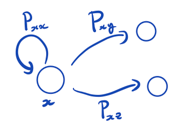
Figure: a discrete-time Markov chain.
The chain jumps to itself with probability 


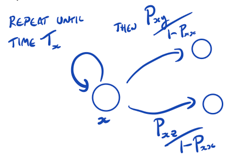
Figure: geometric waiting time interpretation.
That is, the process remains in state 
Now suppose we let 

with 


To ensure probabilities sum to 1, we require

As 

to

while the jump probabilities remain fixed.
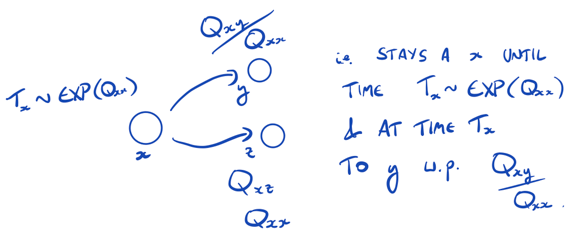
Figure: limiting continuous-time behaviour.
Thus, the process spends an exponential time with parameter 

A formal definition: continuous-time Markov chain
Definition (Q-matrix). A matrix 
for all
for all
Thus, off-diagonal entries are non-negative, diagonal entries are negative, and each row sums to zero. We write 

Definition (continuous-time Markov chain). A continuous-time Markov chain is a stochastic process 


The embedded discrete-time chain 

The holding time in state

The process is constructed via

Facts about continuous-time Markov chains
- The matrix exponential is
- The values
represent transition rates from
is the rate of leaving state
- Definitions of recurrence, transience, irreducibility, etc., extend naturally (with sums replaced by integrals).
![\displaystyle \mathbb{P}(X_t = x) = [\lambda e^{Qt}]_x](https://s0.wp.com/latex.php?latex=%5Cdisplaystyle+%5Cmathbb%7BP%7D%28X_t+%3D+x%29+%3D+%5B%5Clambda+e%5E%7BQt%7D%5D_x&bg=ffffff&fg=1a1a1a&s=0&c=20201002)


 Applied Probability Notes