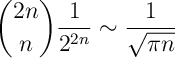
We explain why certain distributions arise naturally as the limit of coin throws.
- Bernoulli, Binomial Distributions, Geometric Distributions.
- Binomial to Poisson Distribution; Geometric to Exponential; Binomial to Normal.
Bernoulli random variables are just choice tosses: heads or tails; zero or one random variables. You can get surprisingly far – perhaps almost everywhere – in probability by summing and limiting sequences of these random variables.
Def [Bernoulli Random Variable] A random variable that takes at most two values is called a Bernoulli random variable. We assume (unless stated otherwise) that these values are zero or one. So

for some . We write
Ex 1 [Bernoulli to Binomial] Let ,
be IID Bernoulli RVs, let

Show that

Ans 1 Probability of ones in a row and
zeros in a row is
. The number of sequence with
ones and
zeros is

Def [Binomial Distribution] A RV has a Binomial distribution, and we write

when

Ex 2 [Bernoulli to Geometric] Consider a sequence of Bernoulli RVs . Let
be the index of the first
in this sequence. Show that

Ans 2

Def [Geometric Distribution] A RV has Geometric Distribution, and we write
if

We now consider some limits of Binomial Random Variables.
Ex 3 [Binomial to Poisson]Consider a sequence of Binomial RVS: for some
. Show that
![{\mathbb P} ( Y^n = k) \xrightarrow[n\rightarrow\infty]{} e^{-\lambda} \frac{\lambda^k}{k!}](https://appliedprobability.blog/wp-content/uploads/2017/07/a0e5137c92ea2a0299311078ccc53f69.png?w=840)
Ans 3
![\begin{aligned} {\mathbb P} ( Y^n = k ) & = { n \choose k } \left( \frac{\lambda}{n} \right)^k \left( 1- \frac{\lambda}{n} \right)^{n-k} \\ & = \left[ \frac{n}{n} \cdot \frac{n-1}{n} \cdot ... \cdot \frac{n-k+1}{n} \cdot \left( 1-\frac{\lambda}{n} \right)^{-k} \right] \left( 1-\frac{\lambda}{n} \right)^n \frac{\lambda^k}{k!} \\ & \xrightarrow[n\rightarrow\infty]{} e^{-\lambda} \frac{\lambda^k}{k!}\end{aligned}](https://appliedprobability.blog/wp-content/uploads/2017/07/7bfa3988cd08e2534fbd3a45c4170196.png?w=840)
Above the term in square brackets goes to one and goes to
.
Def [Poisson Distribution] For parameter , a RV
Poisson distribution and we write
if

Ex 4 [Geometric to Exponential] Consider a sequence of Geometric RVS: for some
. Show that
![{\mathbb P} \left(\frac{X^n}{n} > x\right) \xrightarrow[n\rightarrow \infty]{} e^{-\lambda x}](https://appliedprobability.blog/wp-content/uploads/2017/07/a186b954e058b60e1bee8f25f3fffc6d.png?w=840)
Ans 4
![{\mathbb P} \left( X^n > nx \right) = \left( 1- \frac{\lambda}{n} \right)^{\lfloor nx\rfloor } \xrightarrow[n\rightarrow\infty]{} e^{-\lambda x}.](https://appliedprobability.blog/wp-content/uploads/2017/07/da63272d63d22e8c2c513b48b3d1ed83.png?w=840)
We now work to show that the sum of binomial distributions converges to a specific distribution called the normal distribution.
Thrm [Binomial to Normal] If then
![\mathbb{P} \left( a \leq \frac{ Y - \mathbb{E} Y }{ \sqrt{var(Y) 2n} } \leq b \right) \xrightarrow[n\rightarrow \infty]{} \int_{a}^{b} \frac{1}{\sqrt{2\pi}} e^{ - \frac{x^2}{2} } dx](https://appliedprobability.blog/wp-content/uploads/2017/07/6554a0a4f28895415f8a1d8388323ef6.png?w=840)
Def [Normal Distribution] For mean and variance
we say that
has a normal distribution and write
when

This is a special case of the central limit theorem, and involves several steps.
Ex 5 [Binominal to Normal] If Show that

Ans 6

Cancelling and dividing by gives the required result.
Ex 7 [Continued] Show that

Ans 7 Applying the approximation we have that

Applying this also to the denominator gives the result.
Ex 8 Show, using Stirling’s Approximiation, that, as ,

Ans 8 By Stirlings, $latex n! \sim \sqrt{2\pi n}\cdot e^{-n} n^n$,

Ex 9 [Continued] Argue that Thrm [SL:Bin2Norm] holds i.e. that
![\mathbb{P} \left( a \leq \frac{ Y - \mathbb{E} Y }{ \sqrt{var(Y) 2n} } \leq b \right) \xrightarrow[n\rightarrow \infty]{} \int_{a}^{b} \frac{1}{\sqrt{2\pi}} e^{ - \frac{x^2}{2} } dx](https://appliedprobability.blog/wp-content/uploads/2017/07/6554a0a4f28895415f8a1d8388323ef6.png?w=840)
Ans 9
In our case the probability corresponds to the sum
![\begin{aligned} &\sum_{n } \mathbb{I}\Bigg[a\sqrt{\frac{n}{2}} \leq Y-n \leq b \sqrt{\frac{n}{2}} \Bigg] \mathbb{P} \left( Y = n + k \right) \\ = & \sum_{n } \mathbb{I}\Bigg[a\sqrt{\frac{n}{2}} \leq k \leq b \sqrt{\frac{n}{2}} \Bigg] \frac{1}{\sqrt{\pi n}}\exp \Big\{ -\frac{k^2}{n} + O\Big(\frac{k^4}{n^2} \Big) \Big\} \\ \approx & \int_{a\sqrt{\frac{n}{2}}}^{b\sqrt{\frac{n}{2}}} \frac{1}{\sqrt{n\pi}} \exp \Big\{ -\frac{k^2}{n} \Big\} dk \\ = & \int_{a}^{b} \frac{1}{\sqrt{2\pi}} \exp \Big\{ -\frac{x^2}{2} \Big\} dk\end{aligned}](https://appliedprobability.blog/wp-content/uploads/2017/07/3e290296e0e8389cebfb31035d57f073.png?w=840)
After applying substitution .