Entropy and Relative Entropy occur sufficiently often in these notes to justify a (somewhat) self-contained section. We cover the discrete case which is the most intuitive.
Entropy – Discrete Case
Def 1. [Entropy] Suppose that 



is the entropy of
Def 1. [Relative Entropy] For probability distributions $latex {\mathbb P}=(p_i:i\in {\mathcal X})$ and 
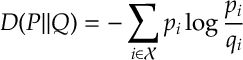
is the Relative Entropy of 

Ex 1. For a vector 

then

Ans 1. Take logs and apply the Stirling’s approximation that 

Ex 2. Suppose that 


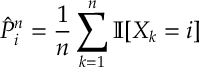
If 


Ans 2. Note that 

Boltzmann’s distribution
We now use entropy to derive Boltzmann’s distribution.
Consider a large number particles. Each particle can take energy levels 


As is often considered in physics, we assume that the equilibrium state of the particles is the state 

Ex 3. [Boltzmann’s distribution] Show that the solution to is given by the distribution

is called Boltzmann’s distribution. The scaling constant 


Ans 3. The Lagrangian of this optimization problem is

So, finding a stationary point

which implies

For our constraints to be satisfied, we require that

Thinking of 

The distribution we derived

 Applied Probability Notes