The M/G/$\infty$ has Poisson arrivals and general service times; here, the number of jobs in service is Poisson distributed. Campbell’s theorem extends the proof idea by giving the moment generating function of sums taken over the points of a Poisson process.
The M/G/∞ Queue
Jobs arrive according to a Poisson process with rate 

Theorem
Suppose that an M/G/∞ queue is empty at time 


Proof
Plot each arrival time on the horizontal axis and the corresponding service time as a vertical height. A job that arrives at time 

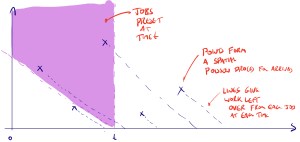
The M/G/∞ queue.
In the figure, the shaded region represents the jobs that are still in the system at time

This proves the result.
□
Campbell’s Theorem
Campbell’s theorem generalizes the preceding Poisson-set argument.
Let 


Campbell’s Theorem
The moment generating function of 
![\displaystyle \mathbb E\!\left[e^{\theta Z_t}\right]=\exp\left\{\lambda\int_0^t\left(\mathbb E\!\left[e^{\theta g_s(X)}\right]-1\right)\,ds\right\}.](https://s0.wp.com/latex.php?latex=%5Cdisplaystyle+%5Cmathbb+E%5C%21%5Cleft%5Be%5E%7B%5Ctheta+Z_t%7D%5Cright%5D%3D%5Cexp%5Cleft%5C%7B%5Clambda%5Cint_0%5Et%5Cleft%28%5Cmathbb+E%5C%21%5Cleft%5Be%5E%7B%5Ctheta+g_s%28X%29%7D%5Cright%5D-1%5Cright%29%5C%2Cds%5Cright%5C%7D.&bg=ffffff&fg=1a1a1a&s=0&c=20201002)
Proof
Conditional on 


![[0,t]](https://s0.wp.com/latex.php?latex=%5B0%2Ct%5D&bg=ffffff&fg=1a1a1a&s=0&c=20201002)
Therefore,
![\displaystyle \mathbb E\!\left[e^{\theta Z_t}\right]=\mathbb E\!\left[\mathbb E\!\left[e^{\theta\sum_{k=1}^{N_t}g_{\tau_k}(X_k)}\mid N_t\right]\right].](https://s0.wp.com/latex.php?latex=%5Cdisplaystyle+%5Cmathbb+E%5C%21%5Cleft%5Be%5E%7B%5Ctheta+Z_t%7D%5Cright%5D%3D%5Cmathbb+E%5C%21%5Cleft%5B%5Cmathbb+E%5C%21%5Cleft%5Be%5E%7B%5Ctheta%5Csum_%7Bk%3D1%7D%5E%7BN_t%7Dg_%7B%5Ctau_k%7D%28X_k%29%7D%5Cmid+N_t%5Cright%5D%5Cright%5D.&bg=ffffff&fg=1a1a1a&s=0&c=20201002)
Conditional on
![\displaystyle \mathbb E\!\left[e^{\theta Z_t}\mid N_t=n\right]=\left(\frac{1}{t}\int_0^t\mathbb E\!\left[e^{\theta g_s(X)}\right]\,ds\right)^n.](https://s0.wp.com/latex.php?latex=%5Cdisplaystyle+%5Cmathbb+E%5C%21%5Cleft%5Be%5E%7B%5Ctheta+Z_t%7D%5Cmid+N_t%3Dn%5Cright%5D%3D%5Cleft%28%5Cfrac%7B1%7D%7Bt%7D%5Cint_0%5Et%5Cmathbb+E%5C%21%5Cleft%5Be%5E%7B%5Ctheta+g_s%28X%29%7D%5Cright%5D%5C%2Cds%5Cright%29%5En.&bg=ffffff&fg=1a1a1a&s=0&c=20201002)
Hence,
![\displaystyle \mathbb E\!\left[e^{\theta Z_t}\right]=\mathbb E\!\left[a^{N_t}\right],\qquad a=\frac{1}{t}\int_0^t\mathbb E\!\left[e^{\theta g_s(X)}\right]\,ds.](https://s0.wp.com/latex.php?latex=%5Cdisplaystyle+%5Cmathbb+E%5C%21%5Cleft%5Be%5E%7B%5Ctheta+Z_t%7D%5Cright%5D%3D%5Cmathbb+E%5C%21%5Cleft%5Ba%5E%7BN_t%7D%5Cright%5D%2C%5Cqquad+a%3D%5Cfrac%7B1%7D%7Bt%7D%5Cint_0%5Et%5Cmathbb+E%5C%21%5Cleft%5Be%5E%7B%5Ctheta+g_s%28X%29%7D%5Cright%5D%5C%2Cds.&bg=ffffff&fg=1a1a1a&s=0&c=20201002)
Using the probability generating function of a Poisson random variable,
![\displaystyle \mathbb E[a^{N_t}]=\exp\{\lambda t(a-1)\},](https://s0.wp.com/latex.php?latex=%5Cdisplaystyle+%5Cmathbb+E%5Ba%5E%7BN_t%7D%5D%3D%5Cexp%5C%7B%5Clambda+t%28a-1%29%5C%7D%2C&bg=ffffff&fg=1a1a1a&s=0&c=20201002)
we obtain
This proves the result.
□
Corollary
If 

Proof
Since 

![\displaystyle \mathbb E\!\left[e^{\theta g_s(X)}-1\right]=\mathbb P(g_s(X)=1)(e^\theta-1).](https://s0.wp.com/latex.php?latex=%5Cdisplaystyle+%5Cmathbb+E%5C%21%5Cleft%5Be%5E%7B%5Ctheta+g_s%28X%29%7D-1%5Cright%5D%3D%5Cmathbb+P%28g_s%28X%29%3D1%29%28e%5E%5Ctheta-1%29.&bg=ffffff&fg=1a1a1a&s=0&c=20201002)
Campbell’s theorem therefore gives
![\displaystyle \mathbb E\!\left[e^{\theta Z_t}\right]=\exp\left\{\lambda\int_0^t\mathbb P(g_s(X)=1)\,ds\,(e^\theta-1)\right\}.](https://s0.wp.com/latex.php?latex=%5Cdisplaystyle+%5Cmathbb+E%5C%21%5Cleft%5Be%5E%7B%5Ctheta+Z_t%7D%5Cright%5D%3D%5Cexp%5Cleft%5C%7B%5Clambda%5Cint_0%5Et%5Cmathbb+P%28g_s%28X%29%3D1%29%5C%2Cds%5C%2C%28e%5E%5Ctheta-1%29%5Cright%5C%7D.&bg=ffffff&fg=1a1a1a&s=0&c=20201002)
This is the moment generating function of a Poisson random variable with mean

This proves the corollary.
□
 Applied Probability Notes