Consider a queue where 


We can think of this as a simple model of a call centre. Some customers receive service immediately when there are idle servers. Otherwise, they must wait in the queue for the next available server.
Here, 


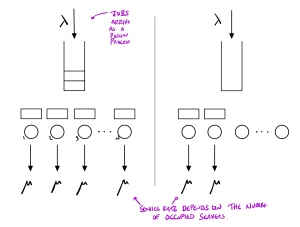
M/M/N queue.
Proposition
The number of jobs in the M/M/N queue is a reversible Markov chain. It is positive recurrent when 
![\displaystyle \pi_n=\begin{cases}\dfrac{\left(\frac{\rho}{N}\right)^{n-N}\frac{\rho^N}{N!}}{\displaystyle\sum_{i=0}^{N-1}\frac{\rho^i}{i!}+\frac{\rho^N}{N!}\frac{N}{N-\rho}}, & n>N,\\[10pt]\dfrac{\frac{\rho^n}{n!}}{\displaystyle\sum_{i=0}^{N-1}\frac{\rho^i}{i!}+\frac{\rho^N}{N!}\frac{N}{N-\rho}}, & n\leq N.\end{cases}](https://s0.wp.com/latex.php?latex=%5Cdisplaystyle+%5Cpi_n%3D%5Cbegin%7Bcases%7D%5Cdfrac%7B%5Cleft%28%5Cfrac%7B%5Crho%7D%7BN%7D%5Cright%29%5E%7Bn-N%7D%5Cfrac%7B%5Crho%5EN%7D%7BN%21%7D%7D%7B%5Cdisplaystyle%5Csum_%7Bi%3D0%7D%5E%7BN-1%7D%5Cfrac%7B%5Crho%5Ei%7D%7Bi%21%7D%2B%5Cfrac%7B%5Crho%5EN%7D%7BN%21%7D%5Cfrac%7BN%7D%7BN-%5Crho%7D%7D%2C+%26+n%3EN%2C%5C%5C%5B10pt%5D%5Cdfrac%7B%5Cfrac%7B%5Crho%5En%7D%7Bn%21%7D%7D%7B%5Cdisplaystyle%5Csum_%7Bi%3D0%7D%5E%7BN-1%7D%5Cfrac%7B%5Crho%5Ei%7D%7Bi%21%7D%2B%5Cfrac%7B%5Crho%5EN%7D%7BN%21%7D%5Cfrac%7BN%7D%7BN-%5Crho%7D%7D%2C+%26+n%5Cleq+N.%5Cend%7Bcases%7D&bg=ffffff&fg=1a1a1a&s=0&c=20201002)
In particular, the probability that a job has to wait is

This is sometimes called the Erlang C formula. The expected waiting time is
![\displaystyle \mathbb E[W]=\frac{1}{N\mu-\lambda}\,\mathbb P(W>0)=\frac{1}{\mu(N-\rho)}\,\mathbb P(W>0).](https://s0.wp.com/latex.php?latex=%5Cdisplaystyle+%5Cmathbb+E%5BW%5D%3D%5Cfrac%7B1%7D%7BN%5Cmu-%5Clambda%7D%5C%2C%5Cmathbb+P%28W%3E0%29%3D%5Cfrac%7B1%7D%7B%5Cmu%28N-%5Crho%29%7D%5C%2C%5Cmathbb+P%28W%3E0%29.&bg=ffffff&fg=1a1a1a&s=0&c=20201002)
Remark. The proof below is tedious but straightforward. Feel free to skip it.
Proof
The queue is a continuous-time Markov chain. Its state is the number of jobs in the system. The transition rate from state 


The detailed balance equations are


Therefore, for 

For 

To find 

Thus,

Together with the expressions for 
The probability that a job has to wait is

The number of jobs waiting for service is 

![\displaystyle \mathbb E[(Q-N)_+]=\sum_{n=N}^{\infty}(n-N)\pi_n=\sum_{n=N+1}^{\infty}(n-N)\left(\frac{\rho}{N}\right)^{n-N}\frac{\rho^N}{N!}\pi_0=\frac{\frac{\rho}{N}}{\left(1-\frac{\rho}{N}\right)^2}\frac{\rho^N}{N!}\pi_0=\frac{\rho}{N-\rho}\,\mathbb P(W>0).](https://s0.wp.com/latex.php?latex=%5Cdisplaystyle+%5Cmathbb+E%5B%28Q-N%29_%2B%5D%3D%5Csum_%7Bn%3DN%7D%5E%7B%5Cinfty%7D%28n-N%29%5Cpi_n%3D%5Csum_%7Bn%3DN%2B1%7D%5E%7B%5Cinfty%7D%28n-N%29%5Cleft%28%5Cfrac%7B%5Crho%7D%7BN%7D%5Cright%29%5E%7Bn-N%7D%5Cfrac%7B%5Crho%5EN%7D%7BN%21%7D%5Cpi_0%3D%5Cfrac%7B%5Cfrac%7B%5Crho%7D%7BN%7D%7D%7B%5Cleft%281-%5Cfrac%7B%5Crho%7D%7BN%7D%5Cright%29%5E2%7D%5Cfrac%7B%5Crho%5EN%7D%7BN%21%7D%5Cpi_0%3D%5Cfrac%7B%5Crho%7D%7BN-%5Crho%7D%5C%2C%5Cmathbb+P%28W%3E0%29.&bg=ffffff&fg=1a1a1a&s=0&c=20201002)
Finally, applying Little’s Law to the waiting queue gives
![\displaystyle \mathbb E[W]=\frac{\mathbb E[(Q-N)_+]}{\lambda}=\frac{1}{\mu(N-\rho)}\,\mathbb P(W>0)=\frac{1}{N\mu-\lambda}\,\mathbb P(W>0).](https://s0.wp.com/latex.php?latex=%5Cdisplaystyle+%5Cmathbb+E%5BW%5D%3D%5Cfrac%7B%5Cmathbb+E%5B%28Q-N%29_%2B%5D%7D%7B%5Clambda%7D%3D%5Cfrac%7B1%7D%7B%5Cmu%28N-%5Crho%29%7D%5C%2C%5Cmathbb+P%28W%3E0%29%3D%5Cfrac%7B1%7D%7BN%5Cmu-%5Clambda%7D%5C%2C%5Cmathbb+P%28W%3E0%29.&bg=ffffff&fg=1a1a1a&s=0&c=20201002)
This proves the result.
□
Example. Suppose that a call centre receives 600 calls per hour and that each call has a handling time of 5 minutes. If calls must be answered within one minute on average, how many operators should the call centre employ?
Remark. Other factors to consider in call-centre design include the number of calls that are abandoned, the number of calls that are blocked, and shrinkage, which is the time during which operators are not available to take calls. One may also need to account for overdispersion in the arrival process, where the variance in the number of arrivals is greater than the mean, unlike in a Poisson process.
Resource Pooling (M/M/N versus N × M/M/1)
There can be significant advantages to combining multiple queues into a single queue. This is an example of resource pooling.
For example, suppose that we compare

Resource pooling.
Suppose that the total arrival rate is 
![\displaystyle \mathbb E[W_{\mathrm{separate}}]=\frac{1}{\mu-\lambda/N}\qquad\text{and}\qquad \mathbb E[W_{\mathrm{pooled}}]=\frac{1}{N\mu-\lambda}\,\mathbb P(W>0)\leq\frac{1}{N\mu-\lambda}.](https://s0.wp.com/latex.php?latex=%5Cdisplaystyle+%5Cmathbb+E%5BW_%7B%5Cmathrm%7Bseparate%7D%7D%5D%3D%5Cfrac%7B1%7D%7B%5Cmu-%5Clambda%2FN%7D%5Cqquad%5Ctext%7Band%7D%5Cqquad+%5Cmathbb+E%5BW_%7B%5Cmathrm%7Bpooled%7D%7D%5D%3D%5Cfrac%7B1%7D%7BN%5Cmu-%5Clambda%7D%5C%2C%5Cmathbb+P%28W%3E0%29%5Cleq%5Cfrac%7B1%7D%7BN%5Cmu-%5Clambda%7D.&bg=ffffff&fg=1a1a1a&s=0&c=20201002)
Since

resource pooling can reduce the expected waiting time by as much as a factor of

