We consider what is perhaps the simplest and most tractable queueing model: a single-server queue with Poisson arrivals and exponential service times. This is called the M/M/1 queue.
Customers arrive according to a Poisson process with rate 

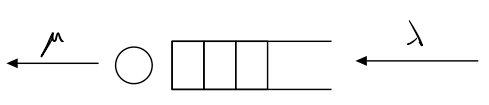
Figure: M/M/1 queue.
Load
We define

to be the load on the system. Jobs arrive at rate 
Since the server processes work at unit speed, a natural condition for stability is

(This works for simple queues like the single-server queue, but more care is needed for networks.)
Kendall’s queueing notation
Kendall introduced a standard notation for queues:

where:
— arrival process
— service time distribution
— number of servers
— system capacity (if finite)
The values 
The symbols
- M — memoryless (exponential)
- D — deterministic
- G — general (i.i.d.)
Kendall notation is widely used, especially for classical models.
M/M/1 queue: stationary distribution
Lemma. The number of jobs in an M/M/1 queue is a reversible Markov chain that is positive recurrent when 

The expected number of jobs in the system is
![\displaystyle \mathbb{E}[Q] = \frac{\rho}{1-\rho}](https://s0.wp.com/latex.php?latex=%5Cdisplaystyle+%5Cmathbb%7BE%7D%5BQ%5D+%3D+%5Cfrac%7B%5Crho%7D%7B1-%5Crho%7D&bg=ffffff&fg=1a1a1a&s=0&c=20201002)
Proof.
The queue length evolves as a continuous-time Markov chain.
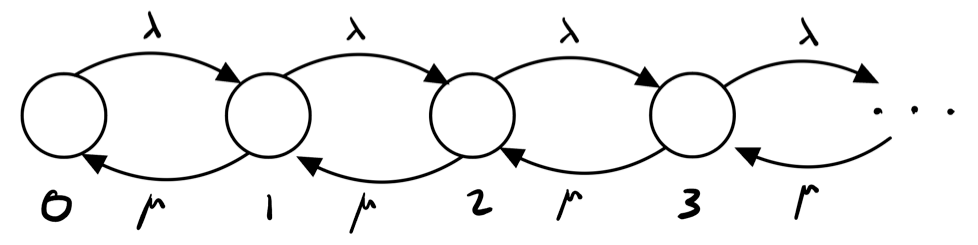
Figure: state transitions with rates 
Using detailed balance,

so

To normalize, we require

so

Since

we obtain

Finally,
![\displaystyle \mathbb{E}[Q] = \sum_{n=0}^{\infty} n \pi_n = \frac{\rho}{1-\rho}](https://s0.wp.com/latex.php?latex=%5Cdisplaystyle+%5Cmathbb%7BE%7D%5BQ%5D+%3D+%5Csum_%7Bn%3D0%7D%5E%7B%5Cinfty%7D+n+%5Cpi_n+%3D+%5Cfrac%7B%5Crho%7D%7B1-%5Crho%7D&bg=ffffff&fg=1a1a1a&s=0&c=20201002)


