- Utility functions and their equivalence
- Risk Aversion.
- CRRA utility and its equivalence with Iso-elastic utilities.
A utility function 

Def 1 [Utility Function] For 



Jensen inequality applies to a concave utility:

So we prefer a certain outcome 
Def 2 [Risk Aversion] If the function is concave then we also say that the function is risk averse. (Unless stated otherwise we assume that the utility function is risk averse).
Def 3 [Equivalent Utilities] We say that two utility functions 


Ex 1 Show that two utility functions are equivalent iff

for constants 

CRRA Utilities
Def 4 [Coefficient of Relative Risk Aversion] For a utility function 

Ex 2 You have utility function 

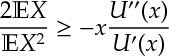
I.e. You accept the bet if you mean is large but a large variance makes this less likely, and the coefficient of relative risk aversion decides the threshold.
Def 5 [CRRA Utility/ [Util:CRRA] A Constant Relative Risk Averse utility (CRRA) takes the form
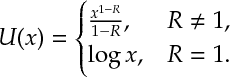
Def 6 [Iso-elastic Utilities] A utility function is Iso-elastic if it is unchanged under multiplication: for all 

I.e. the utility only cares about the relative magnitude of the risk.
Ex 3 Show that a utility function is iso-elastic iff it is a CRRA utility (up-to an affine transform).
Answers
Ans 1 Define 



This implies 
Ans 2. Accept if 
Ans 3 By [1], its immediate that CRRA implies isolastic. Further by [1], 


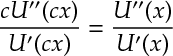
Set 

 Applied Probability Notes