- Continuous-time dynamic programs
- The HJB equation; a heuristic derivation; and proof of optimality.
Discrete time Dynamic Programming was given in previously (see Dynamic Programming ). We now consider the continuous time analogue.
Time is continuous 


Def 1 [Plant Equation] Given function 
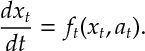
This is called the Plant Equation.
Def 2 A policy 


Def 3 [Continuous Dynamic Program] Given initial state 
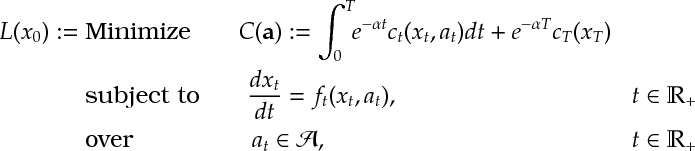
Further, let 


When a minimization problem where we minimize loss given the costs incurred is replaced with a maximization problem where we maximize winnings given the rewards received. The functions 


Def 4 [Hamilton-Jacobi-Bellman Equation] For a continuous-time dynamic program , the equation

is called the Hamilton-Jacobi-Bellman equation. It is the continuous time analogoue of the Bellman equation [[DP:Bellman]].
Ex 1 [A Heuristic derivation of the HJB equation] Argue that, for 

is a good approximation to the plant equation . (A heuristic argument will suffice)
Ex 2 [Continued] Argue (heuristically) that following is a good approximation for the objective of a continuous time dynamic program is

Ex 3 [Continued]Show that the Bellman equation for the discrete time dynamic program with objective and plant equation is

Ex 4 [Continued]Argue, by letting 

Ex 5 [Optimality of HJB]Suppose that a policy 

(Hint: consider 


Answers
Ans 1 Obvious from definition of derivative.
Ans 2 Obvious from definition of (Riemann) Integral and since 

Ans 3 Immediate from discrete time Bellman Equation.
Ans 4 Minus 

Ans 5 Using shorthand 

The inequality holds since the term in the square brackets is the objective of the HJB equation, which is not maximized by 
 Applied Probability Notes