Lyapunov functions are an extremely convenient device for proving that a dynamical system converges.
- For some continuous function
, we suppose
obeys the differential equation

- A Lyapunov function is a continuously differentiable function
with unique minimum at
such that
<img class=” aligncenter” title=”\label{Lya:Lya} f(x)\cdot \nabla L(x)
- We add the additional assumption that
is a compact set for every
.
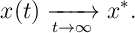
Thrm [Lya:ConvThrm] If a Lyapunov exists for differential equation then 

Proof: Firstly,
<img class=” aligncenter” title=”\frac{d L(x(t))}{dt} = f(x(t))\cdot \nabla L(x(t))
So 


Thus we can take a sequence of times 






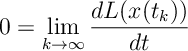

Thus by definition 


- One can check this proof follows more-or-less unchanged if
We now place some assumptions where we can make further comments about rates of convergence.
If we further assume that 
for some
.
such that
.
.

then there exists a constants 




So long as 



Rearrganging gives

This gives exponential convergence in

- We can assume the 2nd assumption only holds on a ball arround
 Applied Probability Notes